Doc2LoRA provides decodable representations of scientific ideas
We construct a map of scientific papers where every point is a large language model, open to questions about the encoded ideas, including regions with no existing papers.
Chand Sahil Mansuri*, Joel Zachariah*, Sadamori Kojaku
School of Systems Science and Industrial Engineering, Binghamton University *Equal contribution
An embedding places a paper as a point in a vector space, turning a body of literature into a map of science. Papers on similar topics cluster together, making it easy to find related work or recommend what to read next. Most embeddings are optimized for search. Reading how papers cluster on this map helps us understand the current landscape of scientific knowledge production.
Beyond search, this map invites generation: mixing papers through simple vector operations creates new points on the map, mirroring combinatorial novelty, the recombination of existing ideas into new ones. The key question we ask is: what idea does a new mixed point represent?
Standard embeddings can't answer this directly because the components of the vector have no clear interpretable meaning. Usually, we check which papers are closest and try to infer the meaning, but this heuristic relies on the premise that nearby papers accurately represent the interpolated area, which does not always hold. Crucially, the most interesting regions—combinations that haven't been tried—are precisely where there are no actual papers.
Every point becomes a model
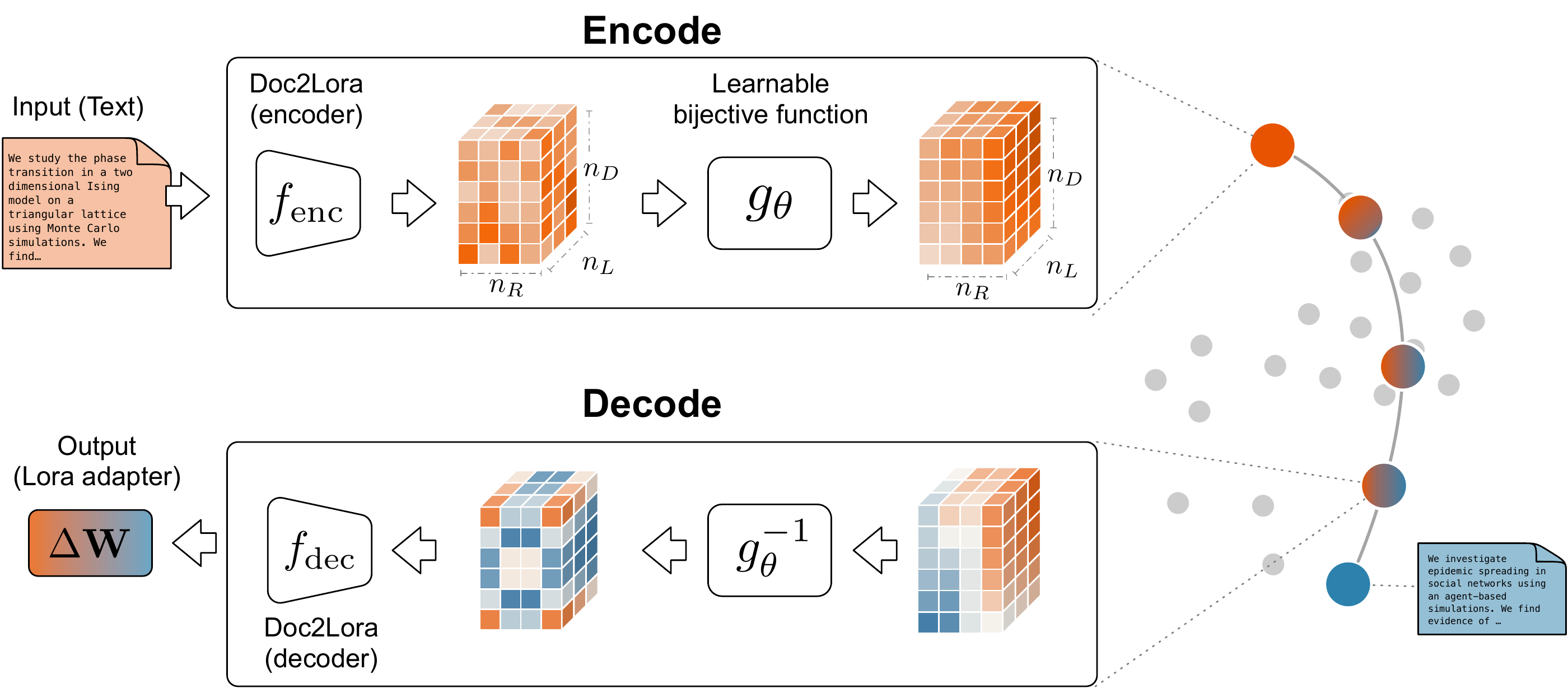
We use Doc-to-LoRA, a hypernetwork that reads a document and creates a LoRA adapter: a small module that changes the output of a language model as if it had read the document.
While large language models have many parameters, the embedding is compact as it contains only the information about the document. It offers idea arithmetic: any point—single document, group average, or an interpolation—can be turned into a LoRA adapter and loaded into a language model for direct question answering.
Figure 1. Doc2LoRA encodes a document to an embedding. A reversible transform g reshapes embeddings for search. Any embedding, including blends, is decoded to a LoRA adapter for the language model.
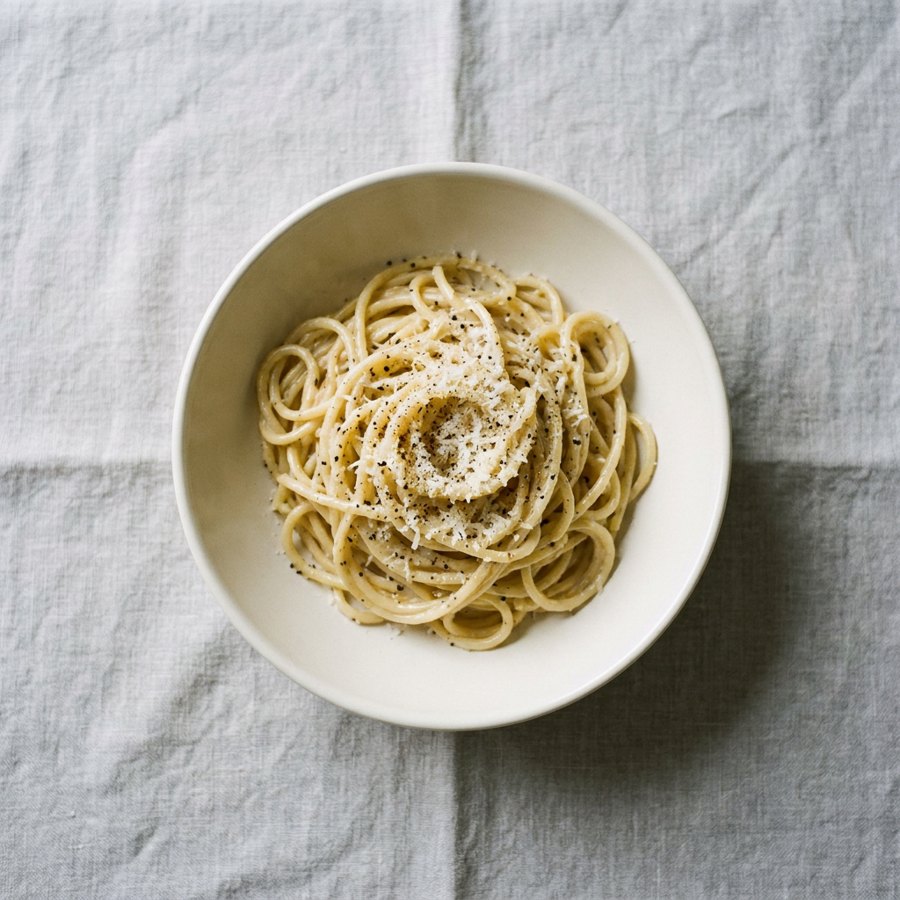
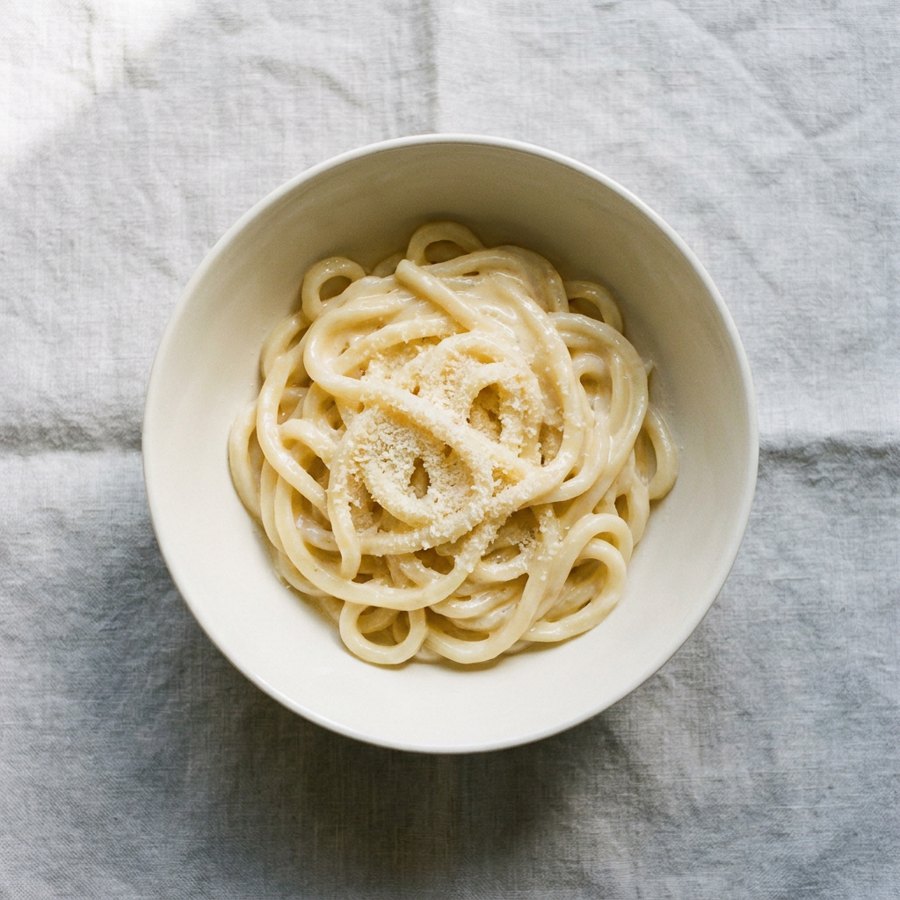
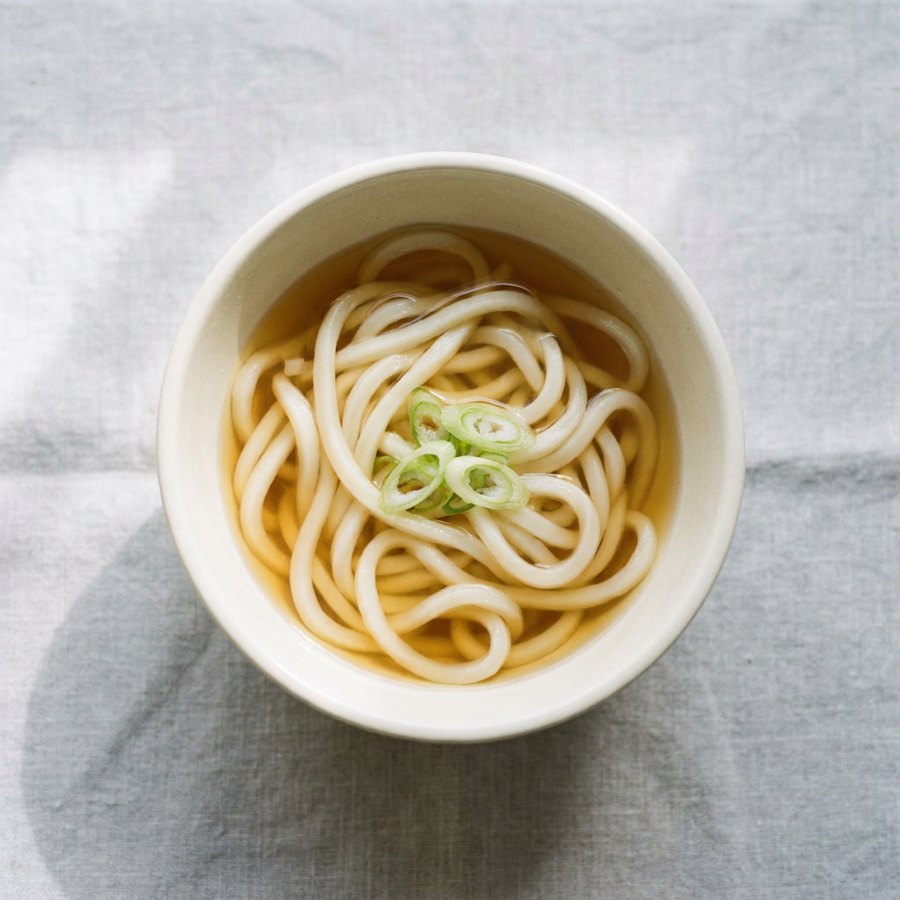
For example: we embedded two recipes, Italian cacio e pepe and Japanese kake udon. The Italian adapter produces “Pecorino Romano” as the cheese. Halfway between the two, the model describes “Kake Udon with Creamy Parmesan Sauce”—mixing noodles from one and cheese from the other.
Cacio e pepe
Halfway: Kake Udon with Creamy Parmesan Sauce
Kake udon
Source document A, as encoded.
Cacio e Pepe (Roman pasta with cheese and black pepper)
A classic recipe of the Roman tradition with only three ingredients. Serves 2.
Ingredients:
- 200 g spaghetti (or tonnarelli)
- 100 g Pecorino Romano cheese, finely grated
- 2 teaspoons whole black peppercorns
- coarse salt for the pasta water
Preparation:
1. Toast the black peppercorns in a dry skillet over medium heat until fragrant, then crush them coarsely in a mortar.
2. Bring a pot of lightly salted water to a boil and cook the spaghetti until one minute short of al dente. Use less water than usual so the cooking water becomes rich in starch.
3. While the pasta cooks, mix the grated Pecorino Romano with a ladle of the hot, starchy pasta water, stirring vigorously until it forms a thick, smooth cream with no lumps.
4. Transfer the spaghetti to the skillet with the crushed pepper, add a splash of pasta water, and finish cooking for one minute, tossing constantly.
5. Off the heat, add the Pecorino cream and toss vigorously, loosening with more pasta water as needed, until every strand is coated in a glossy sauce.
6. Serve immediately with extra grated Pecorino and a final grind of pepper.
Decoded at the midpoint, verbatim. Prompt: “Write out this recipe: give the dish a name, list the ingredients, and describe the preparation steps.”
Recipe Name: Kake Udon with Creamy Parmesan Sauce
Ingredients:
- 200 g fresh udon noodles
- 2 tablespoons unsalted butter
- 2 tablespoons mirin
- 2 tablespoons soy sauce
- 1 teaspoon wasabi paste
- 1/2 cup grated Parmesan cheese
- 1/2 cup heavy cream
- 1 spring onion, thinly sliced
- Optional: a pinch of freshly ground black pepper
Preparation Steps:
1. Cook the fresh udon noodles according to the package instructions. Drain and rinse with cold water.
2. In a deep skillet or pan, melt the unsalted butter over medium heat.
3. Add the mirin and cook fsr 1 minute.
4. Stir in the soy sauce and wasabi paste.
5. Gradually add the grated Parmesan cheese, stirring constantly to prevent lumps from forming.
6. Pour in the heavy cream and bring to a simmer.
7. Cook for 2 minutes, stirring occasionally, until the sauce has thickened.
8. Add the cooked udon noodles to the skillet and toss to coat them evenly with the sauce.
9. Remove from heat and top with the sliced spring onion.
10. Optional: finish with a pinch of freshly ground black pepper.
11. Serve immediately.
Source document B, as encoded.
Kake Udon (Japanese udon noodles in hot dashi broth)
A simple and warming Japanese noodle soup built on dashi stock. Serves 2.
Ingredients:
- 2 portions fresh or frozen udon noodles
- 600 ml dashi stock (kombu and katsuobushi)
- 3 tablespoons soy sauce
- 2 tablespoons mirin
- 1 teaspoon sugar
- 2 spring onions, thinly sliced
- shichimi togarashi (Japanese seven-spice), to taste
- optional toppings: kamaboko fish cake, tempura flakes (tenkasu), a soft egg
Preparation:
1. Make the dashi: soak a piece of kombu in cold water for 30 minutes, bring it almost to a boil and remove the kombu, then add a handful of katsuobushi (dried bonito flakes), turn off the heat, let it steep for 2 minutes, and strain.
2. Season the dashi with the soy sauce, mirin, and sugar, and keep the broth hot over low heat without boiling.
3. Cook the udon noodles in a separate pot of unsalted boiling water according to the package directions, then drain and rinse briefly to remove surface starch.
4. Divide the noodles between two deep bowls and ladle the hot seasoned broth over them.
5. Top with sliced spring onions and any optional toppings, and finish with a pinch of shichimi togarashi. Serve immediately, very hot.
The two recipes and the dish decoded halfway between them. The pictures are illustrations generated with Gemini from each dish's description. Doc2LoRA produces the text, not the pictures.
Map generation results
We evaluated on American Physical Society physics papers labeled by PACS, a hierarchical topic scheme for organizing fields and subfields.
Naming groups of papers
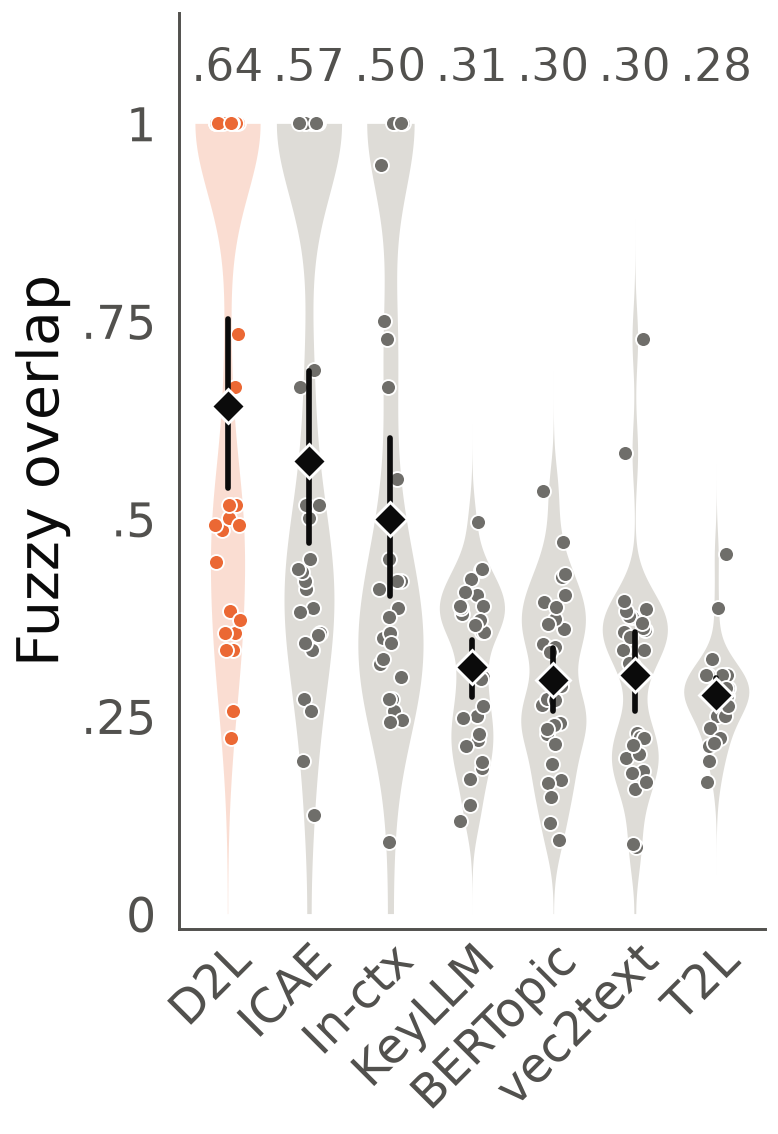
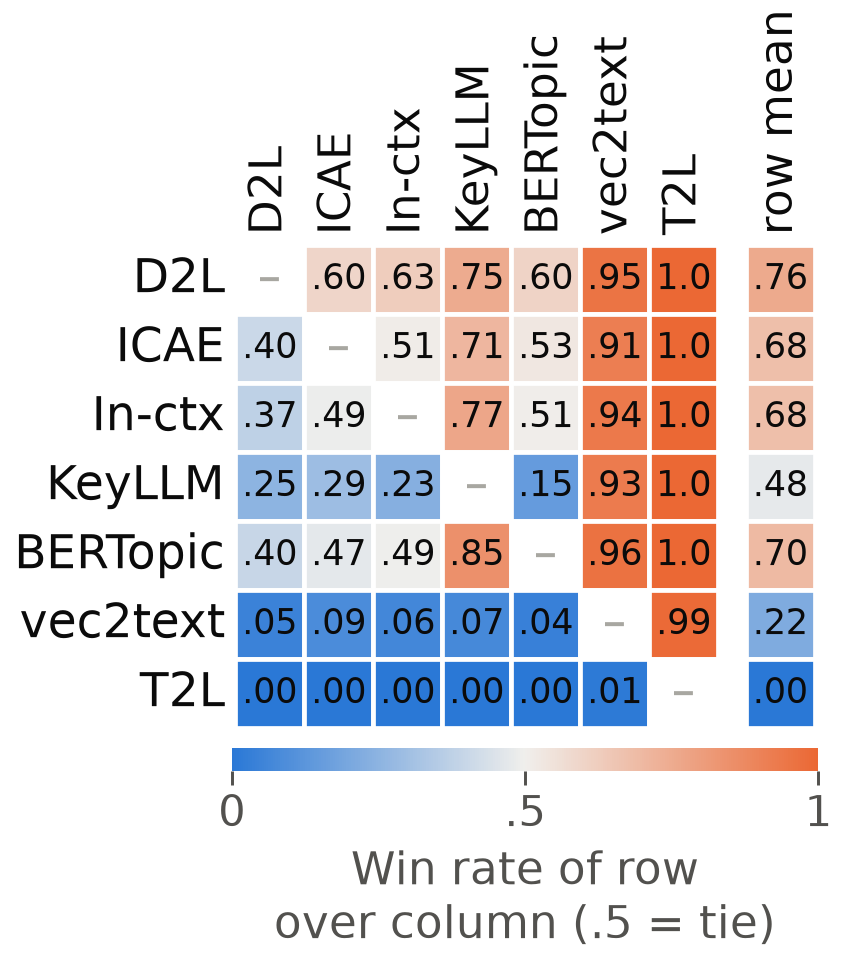
For each topic, we averaged paper embeddings and asked the model to generate a 2-3 word label. We compared these outputs to official PACS names and five baselines (including keyword extraction and vector-to-text decoders). Doc2LoRA's labels best matched the official names by word overlap and were preferred in language model panel comparisons.
Figure 2. Naming 28 physics topics. Left: word overlap between each method's label and the official name (1 = identical). Each dot is a topic; diamond is the mean. Right: panel win rate: how often five language models prefer row over column; 0.5 = tie. D2L: Doc2LoRA; In-ctx: language model receives papers directly; ICAE; KeyLLM; BERTopic; vec2text; T2L: Text-to-LoRA.
Shorter vectors, broader ideas
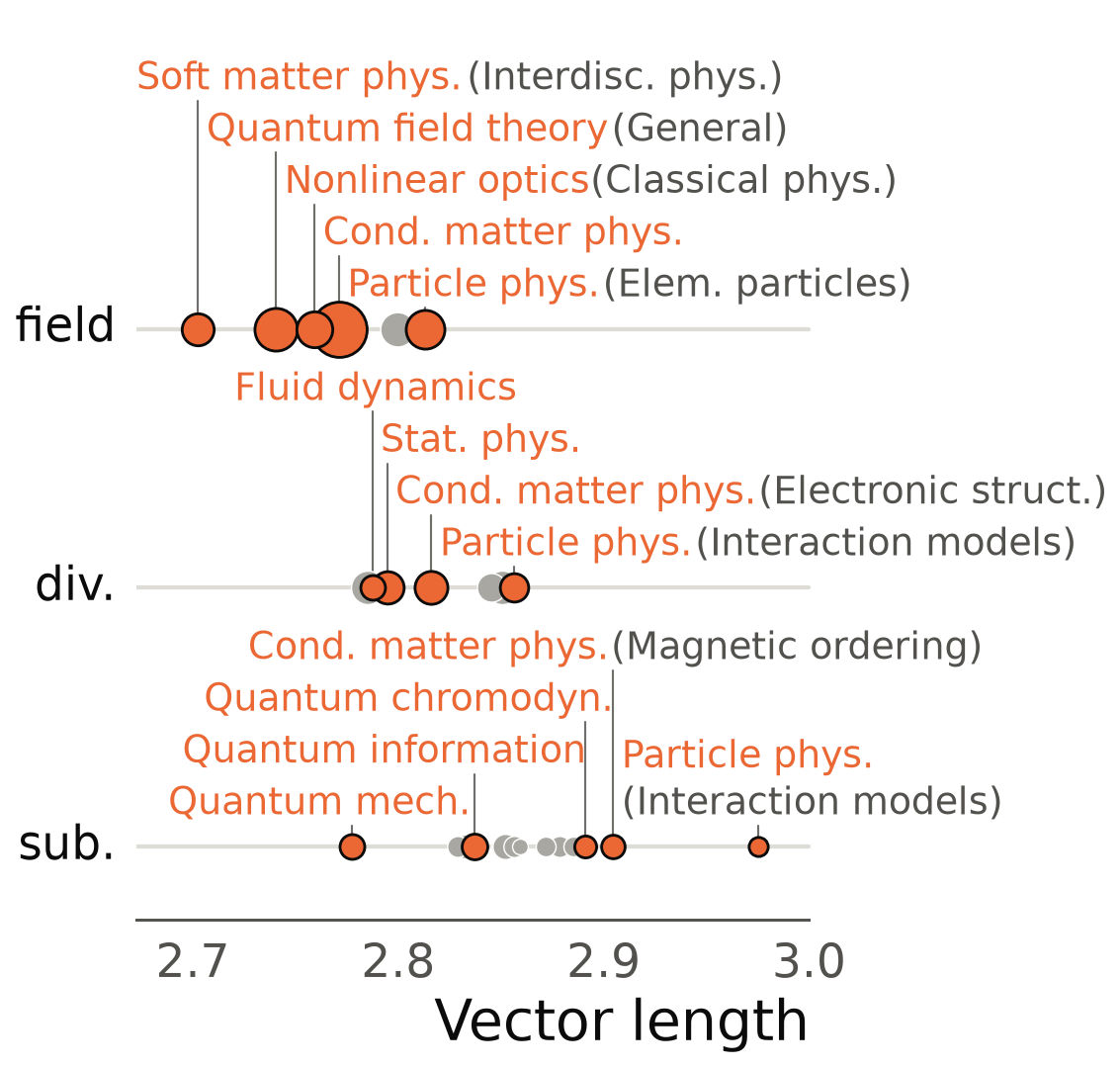
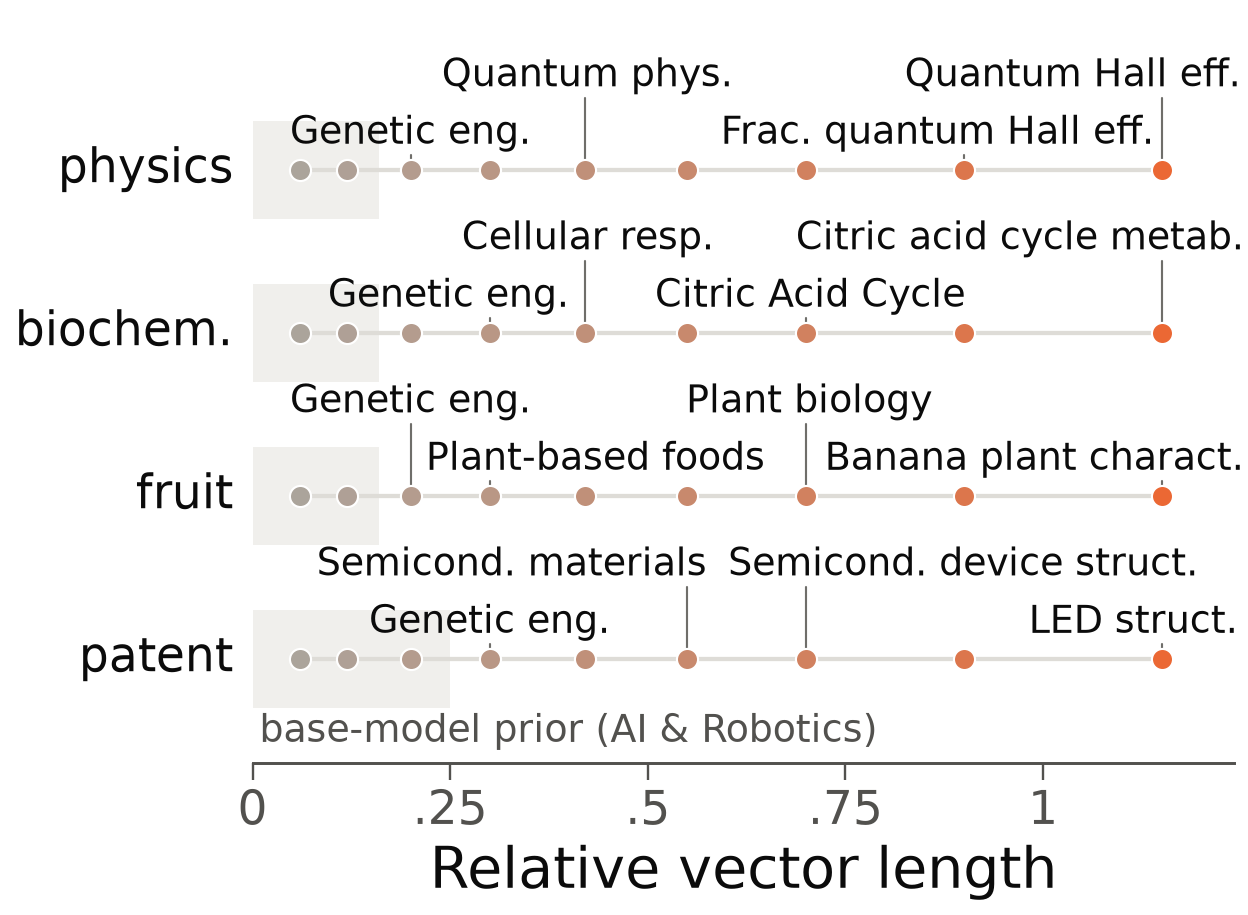
Averaging divergent papers shortens the embedding vector. Shorter vectors tend to be more generic, broader categories, and the level of generality can be controlled by shrinking the vector length (right). Shrinking a Wikipedia article's vector shifts its label from Citric acid cycle metabolism to Cellular respiration. Near zero, the model defaults to its base answer.
Figure 3. Shorter vectors make labels broader. Left: Each row shows average vectors for physics topics by hierarchy level; circle size shows number of papers; orange labels are decoded, grey are official where different. Right: Four Wikipedia article vectors are progressively shrunk; labels update at each step. In the shaded region, the base model output appears.
Reading the space between two papers
We interpolated between two physics papers and, at each point, asked the model to write an abstract. Move the slider to shift the weight from paper A to paper B. Doc2LoRA's abstract follows the weight and combines terms from both papers near the switch, while a language model given both papers and the weight in its prompt blends them at every weight.
Paper APaper B
Doc2LoRA
16 paper-A words · 13 paper-B words
This research investigates the learning of quantum gates in a unitary model of quantum computation, where a quantum system evolves under a unitary transformation and is trained using a quantum neural network. The problem involves determining whether a quantum system can learn a target unitary transformation—possibly imperfect—by iteratively adjusting a set of quantum gates, with the goal of achieving a high fidelity of the learned transformation. The study employs a statistical mechanics approach, specifically the replica method and annealing techniques, to analyze the learning process in the large-N limit, where N represents the number of qubits in the system. The key finding is that the learning process is governed by a critical temperature T, and the asymptotic error rate scales as 1/N² for smooth unitaries, with a universal scaling law that depends on the smoothness of the unitary transformation. For nonsmooth unitaries, the error rate can exhibit a more complex, potentially divergent behavior, and the learning process may fail to converge to a high-fidelity state.
In-context
29 paper-A words · 14 paper-B words
This research investigates the statistical-mechanical behavior of quantum neural networks under the influence of both stochastic training and quantum decoherence, blending the framework of learning from examples (A) with the principles of quantum error correction (B) in a 58:42 proportion. The central problem is to understand how the generalization performance of a quantum neural network—trained on random examples—degrades or improves in the presence of arbitrary decoherence affecting up to t qubits, and whether the statistical-mechanical predictions of generalization curves (e.g., inverse power laws or discontinuous transitions) remain valid in a quantum setting. Using replica theory and the annealed approximation, we analyze the average generalization error as a function of training examples and network size, while incorporating quantum error-correcting codes that protect the encoded information against decoherence. Our findings reveal that for realizable learning tasks, the high-temperature and annealed approximations still provide accurate descriptions of generalization, even when quantum noise is present, but for unrealizable rules, the system exhibits a phase transition to a spin-glass-like state with degenerate minima, analogous to classical perceptrons, yet now stabilized by quantum error correction. We propose a classification of asymptotic learning curves in quantum neural networks, showing that the…
Table 1. Abstracts decoded along the path from paper A, Statistical mechanics of learning from examples, to paper B, Good quantum error-correcting codes exist, two papers from the same physics subtopic. Each cell shows the full decoded abstract; “…” marks where in-context prompting reached the length limit. Words that appear in only one of the two source abstracts are highlighted: paper A’s in blue, paper B’s in orange. The bar above each column shows their ratio. In-context: a language model given both papers and the mixing weight in its prompt.
Adding g greatly improves search
Doc2LoRA is designed for text generation, not ranking. Adding a small reversible transform, g, trained on 42,332 citation pairs from OpenAlex, improves its search results to the level of the commonly used text embeddings. g is the only trained part and preserves reversibility, so all points can be decoded as before.
We evaluated Doc2LoRA (with and without g) against five common text encoders on 14 benchmarks covering four tasks: next-paper prediction, topic classification, collaboration prediction, and author disambiguation. Without g, Doc2LoRA ranks last. With g, it performs on par with EmbeddingGemma and GTE, ahead of Instructor and SPECTER2, and behind SBERT.
Figure 4. Scores on each benchmark; higher is better. Grey markers are the five text encoders, and the grey band spans the worst to the best of them. The line from the open to the filled circle is what g adds, and the number at the right is the size of that gain. Thin whiskers on the Doc2LoRA points show one bootstrap standard deviation and are mostly hidden behind the circles. Each axis is cropped to the range of the scores.All scores
Task
Field / dataset
Doc2LoRA
Text encoders
without g
with g
SBERT
GTE
EmbeddingGemma
Instructor
SPECTER2
Next-paper predictionAUC
Economics
.813±.001
.910±.001
.937±.001
.910±.001
.906±.001
.877±.001
.903±.001
Psychology
.799±.001
.923±.001
.937±.001
.912±.001
.910±.001
.888±.001
.908±.001
Physics
.880±.001
.958±.001
.956±.001
.962±.001
.947±.001
.908±.001
.941±.001
Topic classificationmacro-F1
Economics
.242±.015
.374±.022
.418±.022
.398±.023
.362±.021
.379±.021
.344±.021
Psychology
.217±.010
.340±.020
.366±.023
.350±.019
.358±.020
.348±.026
.319±.020
Physics
.590±.012
.590±.009
.573±.011
.587±.010
.588±.010
.574±.010
.598±.007
Collaboration predictionAUC
Economics
.596±.011
.629±.012
.655±.011
.627±.012
.633±.012
.620±.012
.632±.011
Psychology
.602±.012
.687±.010
.691±.011
.668±.011
.666±.011
.649±.011
.665±.011
Physics
.792±.004
.795±.004
.832±.003
.839±.003
.828±.003
.854±.003
.826±.004
Author-name disambiguationB³ F1
zbMATH
.933±.001
.932±.001
.944±.001
.939±.001
.934±.002
.936±.001
.934±.001
QIAN
.787±.005
.850±.004
.865±.004
.866±.004
.832±.004
.832±.004
.832±.004
ArnetMiner
.678±.004
.708±.005
.698±.005
.698±.004
.706±.004
.679±.004
.669±.004
PubMed
.693±.007
.815±.006
.832±.006
.792±.006
.822±.006
.801±.006
.739±.006
KISTI
.708±.002
.767±.002
.793±.002
.785±.002
.771±.002
.754±.002
.746±.002
Mean ± standard deviation over 1,000 bootstrap resamples. Bold marks the best score in each row. For author-name disambiguation, SPECTER replaces SPECTER2.
Where this goes next
Traditional maps of science show only published work. Here, we built a new map that also covers unexplored areas—spaces between fields and combinations of ideas that haven't been tried. We can target gaps directly: What problem would a paper here address? What methods and experiments could bridge the divide?
This enables new questions: Can we trace a path across disciplines and see how concepts connect? Can we limit the map to papers up to a certain date, generate ideas for the "knowledge holes," and later see if those predictions appear in new research?
We must emphasize that our map reveals potential ideas, but verifying their validity is left for future investigation. The map does not assess how promising an idea is. That judgment is up to people. Yet, we believe that the Doc2LoRA embedding is a powerful tool for generating novel research questions and invites scientific curiosity.
Citation
@misc{mansuri2026doc2lora,
  title         = {Doc2LoRA Provides Decodable Representations of Scientific Ideas},
  author        = {Mansuri, Chand Sahil and Zachariah, Joel and Kojaku, Sadamori},
  year          = {2026},
  eprint        = {2609.38374},
  archivePrefix = {arXiv},
  primaryClass  = {cs.CL},
  url           = {https://arxiv.org/abs/2609.38374}
}
 Cacio e pepe
 Halfway: Kake Udon with Creamy Parmesan Sauce
 Kake udon