loosely woven
The invisible cyborgs
Building my parts
While reading Darek Larson’s blog, I daydreamed about a scene from Psycho-Pass. People in this world are inseparable from AIs—just like us today. Toyohisa Senguji, a man who replaced every part of himself with machines, asks a question that no longer seems like science fiction:

“You probably have home automation and a digital secretary. What would happen to you if all the data in those devices was lost due to a disaster or accident? When you entrust so much of your everyday life to those electronic devices, the argument that you aren’t a cyborg isn’t very convincing. To you, those portable terminals are already your second brain. Isn’t that right?”
We tend to think of ``cyborgs’’ as people with metal limbs. But Senguji suggests we are already there.
Building my parts
I’ve been using Claude Code primarily for coding and writing. But if they can be a part of me, why not delegate some of my important tasks to them, like task management and planning? Just to see how far they can go.
My only concern is that these tasks require another level of trust, and I personally don’t trust them yet to hand over sensitive information to someone behind the AI curtain.
Luckily, ollama recently released a so-called ollama launch feature that lets me use Claude Code with a local model.
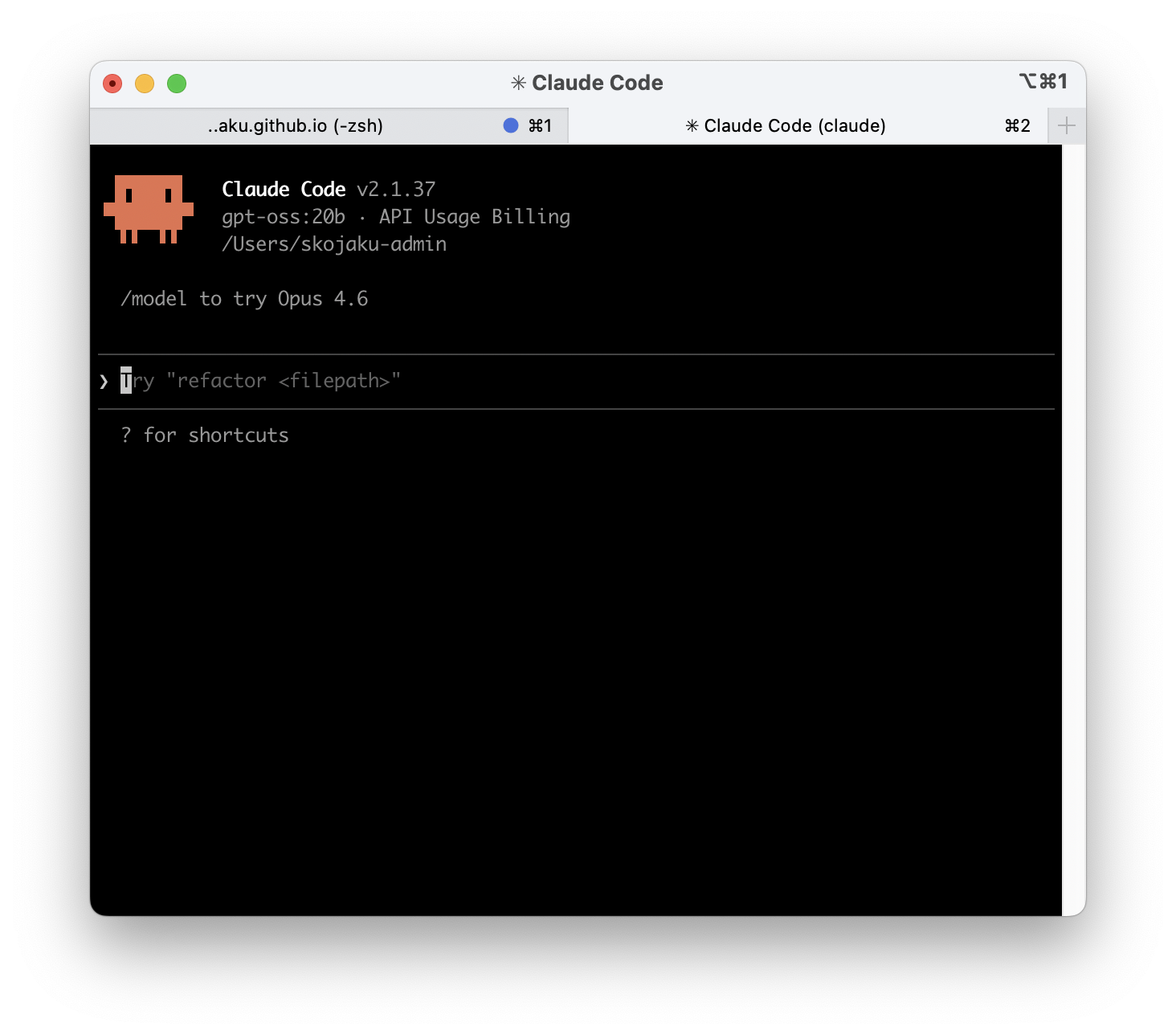
Example
My day begins with making a daily journal, checking emails and todos, and setting priorities. Then I start my tasks. Sometimes, other work or meetings interrupt me, so I update the journal to reflect changes. Can we automate this process?
I created a simple Claude Slash Command named daily as follows.
You are an assistant for daily planning and review.

1. Confirm the date

Check the date and use the data through the session.

date +"%Y-%m-%d (%A, %B %d, %Y)"

2. Collect data

Gather data from the following sources:

- Recent Git activity (last 24 hours):
  bash "$TASKS_DIR/scripts/scan_git_changes.sh" "1 day ago"

- OmniFocus tasks:
  osascript "$TASKS_DIR/scripts/get_omnifocus_tasks.scpt"

- Roadmap or goals files in your notes:
  find "$ROADMAP_DIR" -name "*roadmap*" -o -name "*goals*" -o -name "*plan*" | head -20

- Recent journal entries:
  ls -t "$REVIEWS_DIR"/*.md 2>/dev/null | head -3

3. Triage the data

- Identify the most important/urgent tasks by project. Highlight flagged/due-soon.
- Suggest 3-5 key next steps, based on priorities, deadlines, flags, roadmap, and recent progress.
- Any observations: stalled tasks, idle projects, deadlines, patterns

4. Write the daily report

Be clear and concise. Use this template:

---
date: {YYYY-MM-DD}
type: daily-review
---

Daily Review — {YYYY-MM-DD}

**What I Did Today**
{Summarize git changes: commits, files, projects}

**Active OmniFocus Tasks**
{List most important/urgent tasks by project. Highlight flagged/due-soon.}

**Focus for Today**
{Suggest 3-5 key next steps, based on priorities, deadlines, flags, roadmap, and recent progress.}

**Notes**
{Any observations: stalled tasks, idle projects, deadlines, patterns}

5. Save

Save the review to:
$REVIEWS_DIR/{YYYY-MM-DD}-daily.md

After saving, confirm the file was created and list your top 3 priorities out loud.
[NOTE]
- Environment variables (like
TASKS_DIR,ROADMAP_DIR,REVIEWS_DIR) are set up for these commands.- I use existing scripts to collect the needed data.
- The “Triage the data” step still needs clearer criteria for setting priorities.
This replaces my morning routine. It checks my data and suggests what I should do today, while I’m caffeinating myself with a cup of coffee.
I also made other commands, like /email, which helps check my inbox and interacts with me to book meetings, add new tasks, and draft replies.
These commands often need to access my calendar and email, but Claude Code alone struggles with that. Using Claude Skills solves this; for example, my calendar skill lets /email and /daily work with my calendar app.
What do the invisible cyborgs do for me?
My first impression is that the results aren’t quite like mine. They’re longer and more detailed. But, yeah, I can live with it and it saves me about 10 minutes each day. That’s not bad.
Another unexpected benefit is accountability. I felt like I have someone beside me, checking on my progress and reminding me of my tasks. It helps me stick to my plan and gives me second thoughts, so that I have a broader perspective on what I’m doing.
Conclusion
I’ve become even more reliant on Claude Code. If I lost access, my productivity would drop more than myself before Claude Code came along.
This resonates with Senguji’s point: if losing your digital secretary would disrupt your life, aren’t they already a part of you?
We’re not waiting for metal limbs to become cyborgs. We’re already there, quietly building ourselves piece by piece.
Random thoughts
In The Salmon of Doubt, Douglas Adams wrote:
Anything that is in the world when you’re born is normal and ordinary and is just a natural part of the way the world works.
- Anything that’s invented between when you’re fifteen and thirty-five is new and exciting and revolutionary and you can probably get a career in it.
- Anything invented after you’re thirty-five is against the natural order of things.
To me, the invisible cyborgs are the ones that are against the natural order of things, probably because I’m above thirty-five now. But for younger people, they might be the ones that are normal and ordinary and just a natural part of the way the world works, like those in the Psycho-Pass world.